Stencil: Where Industrial Grid Meets Abstract Circuitry
There’s a unique tension in design when you need to be both commanding and complex. You want the immediate, gut-punch impact of a bold, industrial headline, but you also crave the intellectual depth and "look closer" appeal of fine art. Usually, you have to choose: simple and strong, or detailed and delicate. But what if a single typeface could bridge that gap, offering the structural integrity of a tactical layout fused with the mesmerizing intricacy of a microchip? That is precisely the visual territory Stencil occupies. It reinterprets the classic military spray-shield aesthetic, but instead of hollow centers, it fills every letter envelope with a high-density matrix of maze-like circuit lines and micro-geometric textures. It’s not just a font; it’s a visual statement about the intersection of raw power and intelligent design.
A Typeface Built on Contradiction
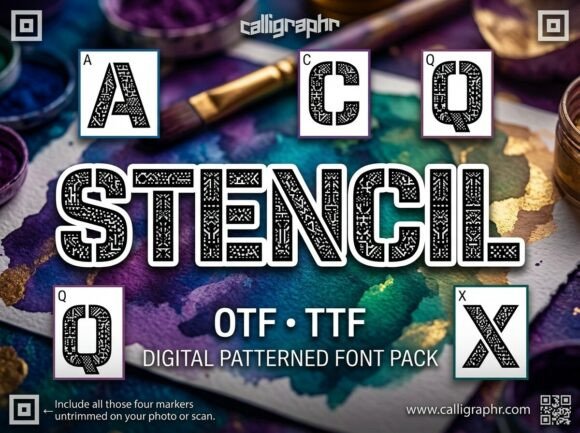
At first glance, you recognize the archetype. It’s an ultra-bold display typeface, heavy block characters that command space with authority. The classic "bridge gaps"—those clean structural slices that define the stencil style—are present, giving it that familiar, industrial feel we associate with crate markings, street signs, and military hardware. This foundation ensures instant legibility and a no-nonsense attitude. But the magic happens when you zoom in. The interior of each character isn’t empty. It’s a dense, intricate web of lines, angles, and circuits, creating a texture that feels both organic and digital.
This dual nature is its greatest strength. The crisp, high-contrast outer contours do the heavy lifting for readability, allowing the letters to pop against almost any background. You can layer it over a wet-paint watercolor texture, a chaotic digital canvas field, or a complex fine-art photograph, and the text will remain perfectly clear. Meanwhile, the internal architecture provides a secondary layer of visual interest, rewarding closer inspection and adding a layer of sophistication that a simple, solid block font could never achieve. It’s a font that respects the viewer’s intelligence.
From Cyberpunk Interfaces to Streetwear Labels
So, where does a typeface like this actually belong? Its personality is so specific that it naturally finds its home in projects that demand a futuristic, high-tech, or alternative edge. Think about the user interface in a cyberpunk video game. You need headers that feel like they’re part of the machine, integrated into the data stream. Stencil’s internal circuitry does exactly that, making the typography feel like a functional part of the world, not just a label on top of it.
That same energy translates powerfully to the world of apparel and merchandise. For a streetwear brand looking to project an image of urban futurism or tech-inspired grit, this typeface becomes a core part of the brand identity. It’s perfect for bold graphic tees, hoodie prints, and sticker decals that stand out in a crowded market. The design is complex enough to be interesting but bold enough to work at a glance on a moving target. It’s a phenomenal creative asset for alternative music album art, where the visual needs to match the intensity and complexity of the sound.
Practical Applications for the Modern Creator
Beyond these obvious fits, the utility of a premium font like Stencil extends into more mainstream design work, provided the project’s goal aligns with its character. It’s about matching the tool to the task. Here’s how different creators can leverage its unique properties:
- Logo Design & Branding: For tech startups, gaming studios, or innovative service firms, a logotype set in Stencil can instantly communicate a brand that is both robust and intelligent. It works exceptionally well for brands that want to be seen as pioneers, bridging the gap between reliability (the stencil structure) and cutting-edge thinking (the internal pattern).
- Editorial & Packaging Design: Imagine a magazine cover for a design publication or a tech review blog. A headline in Stencil can set a definitive tone. Similarly, for packaging—especially for products like craft beer, specialty coffee, or innovative gadgets—it can create a shelf presence that feels premium and thoughtfully designed.
- Marketing & Social Media: In the fast-scrolling environment of social media, you have a split second to make an impact. The bold silhouette of Stencil stops the thumb. Use it for key statistics in an infographic, a powerful quote graphic, or the title of a YouTube video about future trends. Its high-contrast design ensures it remains legible even as a small thumbnail.
- Digital Products & Invitations: For creators selling digital planners, webinar slide decks, or online course materials, using this font for chapter titles or section headers can elevate the entire product, giving it a cohesive, professional, and modern typography feel that justifies a premium price point.
Mastering the Font in Your Workflow
Integrating a display font with this much personality requires a bit of strategy. It’s a star player, not a utility infielder. The first rule is to let it shine in headlines, titles, and short, impactful phrases. Avoid using it for long paragraphs of body copy; the intricate details would become visually noisy and defeat the purpose of readability. Pair it wisely. Its best companions are clean, simple sans serif fonts or even a quiet serif font for body text. Think of a pairing like Stencil for the headline with a font like Helvetica Neue or Garamond for the supporting text. This creates a clear visual hierarchy and prevents the design from becoming overwhelming.
Always test your font pairings in context. Mock up your website header, your product label, or your social media post. See how the text interacts with your chosen color palette and imagery. Does the internal pattern clash with a busy background, or does the strong outer contour hold its own? Review the included font styles—does the pack offer different weights or alternate characters that could give you more flexibility? Finally, for any commercial project, always double-check the licensing. A commercial font license is a legal necessity and a professional courtesy that ensures you can use your design assets with confidence across all your projects, from client work to your own merchandise.
Ultimately, choosing a typeface like Stencil is a decision to inject a specific kind of energy into your work. It’s for projects that refuse to be simple, that want to communicate both strength and smarts. It’s a design asset that doesn’t just spell out words; it builds a visual world around them, one intricate, bridge-gapped letter at a time.